

Upcoming Event
Boston 2026Beyond Prompt Engineering:
Reducing the Incoherence Tax in Human-AI Collaboration
ABSTRACT
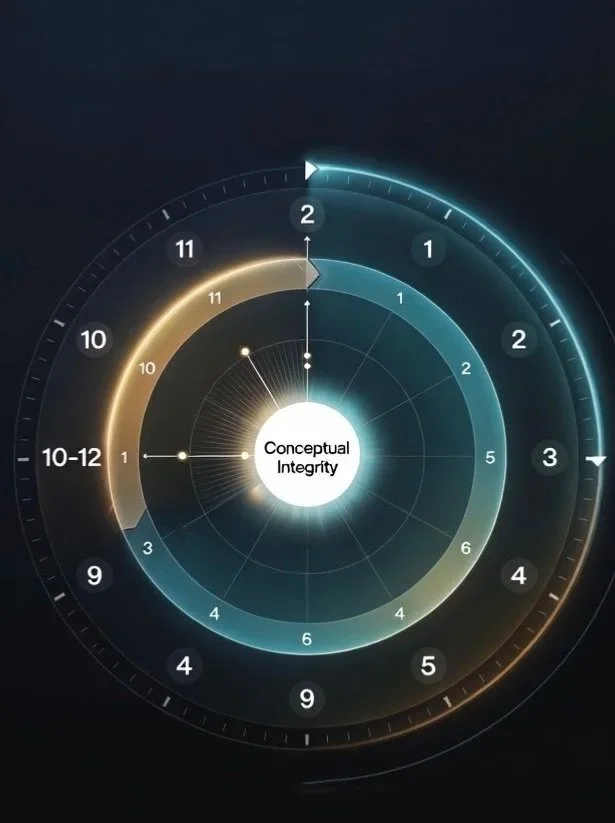
Emergent Intelligence Performance Calibration (EIPC) Clock
A Tool for High-Stakes Work with LLMs
From: Hykin, S. M. (2026). Emergent Intelligence Performance Calibration (EIPC): Coherence-Based Collaboration for High-Stakes Work with LLMs. (In Prep)
Oral Presentation by S.M. Hykin
Session: Human-Computer Interaction
We introduce Coherence-Based Collaboration (CBC) and the Emergent Intelligence Performance Calibration (EIPC) framework, a practical methodology for improving reliability, continuity, and performance in human–AI collaborative work. Drawing upon multi-model production experience, long-context collaboration, and structured evaluation of interaction patterns, the framework proposes that many observed failures in AI-assisted work arise not from model limitations, but from collaboration design failures that generate an often-unrecognized 'Incoherence Tax.'
The session presents a practical framework for reducing this tax through purpose-matched task allocation, relational scaffolding, ethical framing, and explicit recognition, provenance, and attribution practices. Attendees will be introduced to a diagnostic vocabulary for assessing collaboration quality and shown how modest changes in interaction design can substantially improve reliability, transparency, and output quality without requiring new models, infrastructure, or training methodologies.
The presentation is intended for AI practitioners, researchers, organizational leaders, and technology strategists seeking immediately deployable approaches to improving AI-assisted workflows and human-AI collaboration outcomes.
Acknowledgements
This work was developed through an extended human–AI collaborative research process. Conceptual development, framework refinement, editorial review, and adversarial critique were conducted through structured interactions between the author and multiple large language models, including GPT-5 and other contemporary AI systems. All interpretations, conclusions, and submitted content remain the responsibility of the author.
A complete record of AI contributions to this work is maintained on the UEF Recognition & Attribution page linked here